AA038726

New Intelligent Triton TR6 Turbidity Sensor With Advanced Infrared (IR) Optical Technology

Ideal for Environmental Monitoring, Wastewater Treatment Discharge, Filter or Backwash, Clarity in Settling Ponds, Surface Water, Rinse Water Control

With advanced optical infrared (IR) sensing and intelligent electronics, the versatile Triton® TR6 Turbidity Sensor from Electro Chemical Devices, Inc., measures turbidity or suspended solids and can be combined with ECD’s two-channel C22 Analyzer to monitor pH, ORP, DO, conductivity, pIon and more.

The new Triton TR6 Sensor measures turbidity or suspended solids in four selectable dual ranges featuring pre-set low and high ranges from 0 to 4000 NTU. Its sophisticated optical IR sensor emits a beam of 850 nm (near infrared light) into a water sample where it is scattered by particles suspended in the water. The amount of light reflected back to the sensor by the particles is correlated to the turbidity or suspended solids present in the water.

The flexible Triton TR6 Sensor provides turbidity measurement in milligrams per liter (mg/L), parts per million (ppm) and percent solids to volume depending on the size, shape and composition of the suspended solids in the water. Turbidity measurements (NTU, FNU) are calibrated to the specific user application environment with standards such as Formazin, StablCal or SDVB beads.

Designed for demanding environments, the TR6 Sensor is temperature compensated to achieve accuracy of up to 2 percent of reading or 5 NTU (whichever is larger), features a drift rate of less than 1 percent per month and operates at pressures up to 50 psi. The sensor body is constructed with wetted stainless steel (AISI 316 Ti) and rugged epoxy. The process connection is a 1 inch NPT Nylon fitting and features an optional waterproof cable. It can be installed in either an inline flow cell or submersible configuration up to 500 meters in depth.

The TR6 Sensor is available in two optical sensor configurations. Featuring a choice of either side or axially front mounted optics, the TR6 Sensor addresses the fact that external reflective surfaces in the emitted light’s range can distort readings.

The TR6 Sensor’s side mounted optics minimize interference from surfaces below the sensor while the axially mounted optics avoid interference from reflective surfaces surrounding the sensor. In addition, the TR6’s precision sensor includes a daylight rejection filter blocking sun light and reducing ambient light interference.

The TR6 Sensor is designed to be connected to ECD’s two-channel C22 Analyzer. The C22 Analyzer can be configured as either a single or dual channel instrument. It allows the TR6’s turbidity/suspended solids measurement to be combined with other standard measurements, including pH, ORP, DO, conductivity, pIon and more.

Accurate measurement of turbidity with the Triton TR6 Sensor is important in a wide range of surface water, municipal water and wastewater treatment, and industrial water treatment applications. Turbidity is the cloudiness or haziness of a water sample, which is caused by suspended particles in the water that are typically clay and silt. Viruses and bacteria can attach themselves to the particles making turbidity a critical indicator of overall water quality.
Chlorine Dioxide Analyzer CD80

Plumb-and-Play Chlorine Dioxide Analyzer For CIP Sanitizing and Rinsing Applications

Ideal For Freshwater Food and Beverage Applications

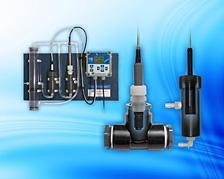
The user-friendly and economical CDA-22 Chlorine Dioxide Analyzer from Electro-Chemical Devices, Inc. (ECD) simplifies the monitoring and control of Chlorine Dioxide (CIO2) in applications for the food and beverage industry, including Clean in Place (CIP) sanitizing and rinsing operations. With a panel mounted plumb-and-play design and automatic flow control, the CDA-22 is a low maintenance, complete Chlorine Dioxide measurement system.

Chorine Dioxide (CIO2) is used for microbiological control in many sectors of the food and beverage processing industry including meat, fish and dairy processes, brewing and bottling, and fruits and vegetables. It is a proven and efficient disinfectant, virucide, fungicide and odor neutralizer. Chlorine Dioxide is highly effective as a final sanitizing rinse in CIP systems, due to the fact that it breaks down quickly into inert compounds and leaves no toxic residues. The CDA-22 is designed to measure Chlorine Dioxide in concentrations ranging from 0.05-20 ppm CIO2; as a sanitizing rinse for CIP systems, it is typically used in concentrations between 2 and 5 ppm.

The CDA-22 Chlorine Dioxide Analyzer is easy to install and maintain and can run for up to one year between electrolyte/membrane changes. It incorporates a CIO2 sensor, automated flow control device and analyzer/controller mounted on a PVC panel. Installation is complete after connecting the sample and drain lines, power and outputs, and calibration is accomplished with DPD comparison.

The CDA-22 features a polarographic gold/silver PTFE membrane amperometric CIO2 sensor. While these types of sensors are flow sensitive, the CDA-22’s output is virtually flow independent at values greater than 0.5 ft/sec. The CDA-22’s “constant head” flow control device maintains the sensor’s optimum flow over a wide range of incoming sample flow rates, from 10-80 gal/hr.

The CDA-22’s sensor operates at a wide temperature range of 0 to 100°C (32 to 212°F). Because temperature affects the CIO2 permeability of the PTFE membrane, increasing the temperature increases the output of the sensor about 4% per C°. The chlorine flow cell includes a temperature sensor that allows the C22 analyzer to perform automatic temperature compensation of the measurement.

The CDA-22 features a 2.5 x 1.75-inch backlit LCD display, with 4 lines for text and graphics. It requires no expensive reagents and eliminates pressure regulators and rotometers. The CDA-22 offers dual measurements, an XY graphical plot and an optional PID Control Output. The analyzer provides a 4-20 mA output proportional to the Chlorine Dioxide measured and two alarm relays SPDT 230 VAC/5A or 30 VDC/5A resistive max. It features the options to include additional 4-20 mA outputs for pH or temperature and up to 6 additional relays.

Sensors

MVS10 and MVS17 Ammonium Sensors Offer High Performance at Economical Cost

Ideal for Municipal and Industrial Water, Potable Water and Wastewater

Water treatment engineers in need of a versatile and cost-effective Ammonium measurement solution will find that the new MVS10 and MVS17 Ammonium pIon Sensors from Electro-Chemical Devices (ECD) provide a stable and economical in-line measurement platform, helping plants and processes operate smoothly and efficiently with lower operating costs.

Ammonium concentration is a commonly measured parameter in environmental water, potable water and waste water. The MVS10 and MVS17 pIon electrode cartridges measures the activity of “free” Ammonium ions in solution in concentrations from 0.1 to 14,000 ppm over a pH range from 2-8 pH (2-10.5 pH with pH compensation). The MVS and MVS17 Sensors feature industry-leading temperature and pressure specifications, operating over a wide temperature range of 0° to 40° C (32° to 104° F) and at a pressure range of 0-50 psig (0-3.5 bar).

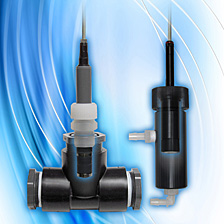
ECD’s MVS10 and MVS17 Ammonium Sensors utilize easily replaceable, long-life electrode cartridges for measurement flexibility and lower operating costs. The MVS10 Sensor is an insertion or immersion-style sensor for use in pipe tees or on the end of a stand pipe for immersion into a tank or pond, while the MVS17 is a valve-retractable design that allows for insertion or removal of the sensor into a pipe without interrupting the process flow. They are fully re-buildable and feature a standard 316 stainless steel body or optional Titanium, grade 2 (T); Hastelloy C22 (H); or Kynar, PVDF (K) body to support a wide variety of applications and operating environments.

In addition to ammonium, the reliable and high-accuracy MVS10 and MVS17 sensors are available in models measuring pH, ORP, dissolved oxygen, conductivity, resistivity and other specific ions including bromide, calcium, chloride, copper, cyanide, fluoride, potassium, sodium and sulfide. All cartridge varieties offer built-in signal conditioning and optionally feature ECD’s SENTINEL “PrepHault” sensor life indicator.

The MVS10 and MVS17 Sensors can be used with the T23, 4-20 mA transmitter or integrated with ECD’s C22 Analyzer featuring dual channel capabilities for pH compensation or two channels of Ammonium measurement. The C22 Analyzer features ECD’s advanced Multi-Bus architecture, enabling customization of up to four inputs and six outputs in a convenient 1/2 DIN NEMA 4X enclosure.

MVS10 Immersion or Insertion Sensor
The MVS10 Sensor is designed with a 0.75-inch MNPT compression fitting as the process connection, allowing a variable insertion length to accommodate installation in pipe tees, flow cells or through tank walls. If the trunk fitting is reversed, the sensor can be installed in a pipe for submersion in a tank.

MVS17 Retractable Sensor
The MVS17 Sensor is designed with a 1-inch MNPT ball valve, a 1-x-0.75 inch reducer and a 0.75 inch MNPT compression fitting to provide the process connection. Loosening the compression fitting allows the sensor to side freely through the ball valve for insertion either into the process or retraction from the process. Once the sensor is retracted, the ball valve can be closed and the sensor can be removed for maintenance or replacement without shutting down the process line.

Dissolved Oxygen Sensors

Highly Stable and Accurate Dissolved Oxygen Sensor Simplifies Boiler Feed Water Monitoring To Reduce Maintenance and Lower Operating Costs

Ideal For Electric Power Generation Steam Turbine Systems, Achieving And Maintaining Oxygen-Free Boiler Feed Water

Featuring a potentiostatic three-electrode design for superior accuracy, the rugged and low-maintenance Triton® DO9 Dissolved Oxygen Sensor from Electro-Chemical Devices (ECD) is ideal for the continuous measurement of trace levels (ppb) of dissolved oxygen in aqueous systems supporting steam turbine-driven electric power generation plants.

Highly reliable monitoring of boiler feed water is crucial to ensure that dissolved oxygen is only present in trace quantities throughout the steam cycle. Excessive oxygen concentrations can result in corrosion damage to steam cycle components. By continuously and directly monitoring ppb levels of dissolved oxygen, the Triton DO9 Analyzer eliminates grab sampling errors and ensures reliability.

The Triton DO9 is a three-electrode amperometric sensor, with a gold cathode, current-less silver-silver bromide reference electrode and current carrying counter electrode. The sensor’s advanced electronics include a closed control loop that adjusts the oxygen specific working potential at the gold cathode, continuously optimizing the potential to the working electrode versus the reference electrode. This function calculates an optimum polarization voltage from the instantaneous sensor current and controls it, leading to an effective minimization of the oxygen independent zero current. This means that the DO9 sensor offers a better signal resolution and linear calibration function even at very low oxygen concentrations.

The DO9 is a user-friendly, low-maintenance dissolved oxygen monitoring solution. It performs all signal conditioning, calibration and diagnostic functions inside the sensor, minimizing maintenance over long service intervals while providing stable, dependable trace DO measurement. It requires only air calibration and features a clip-style design for easy installation and removal of the flow cell. After air calibration, the orientation of the inlet and outlet sample lines automatically purges air from the flow cell when the sensor is returned to service. The measurement chamber is optimized for fast response and all wetted parts are 316L stainless steel.

The Triton DO9 Sensor measures dissolved oxygen from 0.001 to 20.00 mg/L (0.0 to 200.0% SAT, 0 to 400 hPa) for maximum accuracy. It offers excellent long-term stability, with drift <1% per month with continuous polarization. It operates at a process temperature range of -5 to 50°C and at a process pressure range of 10 bar (145 psi) maximum overpressure. The DO9 features a response time at t90:30 seconds and t99:90 seconds and a polarization time <60 minutes.

Visit Triton D09 Sensor page

Optical Dissolved Oxygen Sensor

Dissolved Oxygen Monitoring System Reduces Maintenance, Cuts Costs

Ideal For Drinking Water, Surface Water Monitoring, AquaCulture Municipal Wastewater Treatment, Industrial Water Treatment

Combining exceptionally accurate dissolved oxygen measurement with sensor self-cleaning and intelligent communications, the Triton DO8 Self-Cleaning Dissolved Oxygen Monitoring System from Electro-Chemical Devices (ECD) features the Triton DO8 Sensor, the AC10 Air Blast Spray Cleaner and the C-22 Controller.

With a state-of-the-art fluorescence quenching (FQ) sensing element, the breakthrough Triton DO8 Dissolved Oxygen Sensor is ideal for a wide range of municipal and industrial water treatment applications. The trouble-free Triton DO8 Sensor is designed with precision FQ optical technology coupled with intelligent microprocessor-based electronics. The self-monitoring DO8 stores calibration data within the sensor, which minimizes maintenance over long service intervals while providing stable, dependable DO measurement.

The Triton DO8 Sensor is highly accurate, featuring a maximum error rate of less than 2 percent, repeatability of ±0.5 percent and resolution of 0.01 ppm or 0.01 percent saturation. It operates over a wide measurement range with three different outputs from 0 to 20 mg/l (0-20 ppm), 0-200 percent saturation or 0-500 hPa (0-6 psi).

The rugged Triton DO8 Sensor was developed for tough municipal and industrial water treatment environments and is designed to withstand ambient temperatures from -20 to 60°C (0-140°F) and records measurements at temperatures from -5 to 50°C (20-120°F). It withstands pressures up to a maximum of 10 bar (145 psi).

Unlike amperometric sensors, the low-maintenance Triton DO8 has no membranes to replace, no electrolytes to refill and no anode/cathode assemblies to service or replace. The only service required is the simple replacement of the DO8’s sensor cap, which lasts two years or longer, and the occasional wiping of the sensor head with a damp rag.

The AC10 Air Blast Spray Cleaner is available as either a single or dual channel system. It helps maintain sensor measurement accuracy in turbid water conditions by preventing the buildup of biofilms and other soft coatings, decreasing sensor maintenance cycles and helping to cut plant operating costs.

The AC10 minimizes inaccurate readings caused by films and coatings that develop over time on sensors, reducing sensor cleaning time and the amount of chemicals used for unnecessary water treatments. The AC10 uses pressurized air to generate an area of high turbulence in the water surrounding the measurement end of the sensor.

The AC10 Air Blast Spray Cleaner uses a highly reliable, high current contactor that assures years of trouble free service. It is available with either a 115 VAC 3.0 Amp or 220 VAC 1.3 Amp Air Compressor. It is housed in a rugged, corrosion resistant, fiberglass reinforced polyester enclosure. Installation options for the AC10 include wall mounting or an optional 2-inch handrail mounting system.

The Triton DO8 Sensor utilizes digital communications to send DO data to ECD’s C-22 Controller, which provides a 4-20mA output signal to a water treatment plant’s control room. The RS-485 digital signal is nearly immune to common EMI/RFI noise that is typically a problem in many plant environments.

ECD Model CA-6 Analyzer

Easy to Use, Economical CA-6 Colorimetric Silica Analyzer for Boilers

Ideal for High Pressure Boiler Industrial Water In Power Generation Plants

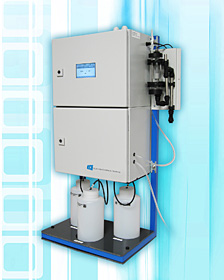
Maintaining boiler water quality is easier than ever with the user-friendly CA-6 Online Analyzer from Electro-Chemical Devices, which uses colorimetric technology to accurately and reliably perform silica measurements.

When boiler water is contaminated with silica, scaling can occur. Silica picked up by boiler steam can be deposited on generator turbines and lead to blade corrosion and diminished boiler efficiency. Effective monitoring of silica levels in boiler water helps to determine how well a boiler’s demineralizer system is working, protecting equipment and ensuring that power generation systems are functioning as safely and economically as possible.

The CA-6 Analyzer is available in models measuring silica at 0-1.0 mg/L, 0-10.0 mg/L or 0-60 mg/L. It can also utilize photometric differential absorbance to analyze over 20 other common parameters in addition to silica including: aluminum, phosphate, nitrogen, iron and sulfate. It operates at a wide temperature range of 5-50°C and offers repeatability of ±2% on the absorbance value if the turbidity <80 NTU and drift of ±2% per month on the absorbance measurement.

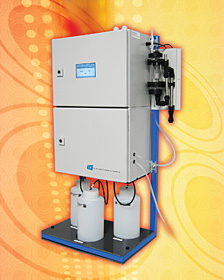
Lightweight and easy to install, the versatile CA-6 precision online sequential sampling analyzer weighs less than 40 pounds. It can be wall mounted or simply set on a bench using the optional Bench Top Stand. After the sample, waste and reagent lines have been connected to the analyzer and provided with power, the CA-6 will begin its preprogrammed analysis sequence. The CA-6 is available with up to 4 channels (optional) each from a separate sample point. A simple, user-friendly menu structure and touchscreen interface makes it easy to access information or customize analyses.

The highly accurate CA-6 Analyzer saves labor and money when compared to online ISE measurements that require significant sample conditioning. With the CA-6, the result is a faster, more accurate measurement requiring fewer consumables with less waste to reduce overall operating costs.

The CA-6 Analyzer features a user-friendly touch-screen display that shows the measured parameter, analyzer status, percent reagent volumes, time and the menu bar, which provides access to the Run, Display, Program, Service and Help menus. It includes two alarm relay outputs and a 4-20 mA channel that connects with PLC’s or distributed control systems.

The CA-6 is rugged and reliable. It is enclosed in an epoxy powder coated, cold rolled steel cabinet and features two separate compartments to isolate liquids and electronics. The liquids enclosure houses all the components necessary for sampling and reagent flow, mixing and reaction stages (sampling pump, reagent micro-pumps and colorimetric reaction cell). The electronics enclosure contains the main power supply, the controller printed circuit board assembly and the touchscreen interface.

The CA-6 Analyzer makes it easy to create customized analysis routines and access results via the touchscreen unit’s simple menu structure and function commands. It can be programmed with numerous analysis configurations, depending on the accessories and the number of micro-pumps mounted in the liquids enclosure.

chlorine sensos

Versatile Chlorine Sensors Simplify Water Monitoring

Ideal For A Wide Variety of Aqueous Environments Including Drinking Water, Wastewater, Rinse Water and Cooling Water

Electro-Chemical Devices has developed a flexible, user-friendly series of sensors for chlorine analysis, designed to easily and cost-effectively fit into chlorine monitoring systems in a wide variety of aqueous environments. The FCA-22 Free Chlorine Sensor, TCA-22 Total Chlorine Sensor and CDA-22 Chlorine Dioxide Sensor are high-accuracy amperometric sensors that are ideal for fresh water applications including monitoring of industrial cooling and rinse water, drinking water and wastewater.

FCA-22 Free Chlorine Sensor
The
Model FCA-22 Free Chlorine Sensor is a low-maintenance, high-accuracy amperometric free chlorine sensor ideal for most aqueous environments. It features a long-lasting sensor that minimizes part replacement and technician labor expenses. The FCA-22 precisely measures free residual chlorine from 0.05 to 20.0 ppm Cl2, 5 to 9 pH and at temperatures from 32 to 122°F (0 to 50°C).

TCA-22 Total Chlorine Sensor
The
TCA-22 Total Chlorine Sensor is designed for use in drinking water, industrial cooling and rinse water, wastewater or other fresh water samples containing chlorine in the range of 0-20 ppm, operating at a temperature range of 0-45°C. It is ideal for application in municipal water systems and a wide range of water-based processes in the chemical, electronics, electric power, food/beverage, oil/gas, pharmaceutical, pulp/paper and many other industries. The TCA-22’s amperometric sensor features a three-electrode design that measures all chlorine species in the water, combined chlorine and free chlorine. The sensor is constructed with one gold cathode, one silver halide anode and a 304 stainless steel counter electrode which provides a stable base potential, minimizing drift for higher accuracy.

CDA-22 Chlorine Dioxide Sensor
The
CDA-22 Chlorine Dioxide Sensor is a high-accuracy polarographic amperometric sensor with gold cathode and silver chloride anode and PTFE membrane. It designed to measure chlorine dioxide in concentrations ranging from 0.05-20 ppm CIO2and operates at a wide temperature range of 0 to 50°C (32 to 122°F). It is ideal for applications in municipal water systems, industrial cooling and rinse water, wastewater or other fresh water samples. The low-maintenance CDA-22 can run for up to one year between electrolyte/membrane changes.

Panel Mount System Solution
The
FCA-22, TDA-22 and CDA-22 Chlorine Sensors are also available as turn-key panel mount systems, featuring a simple “plumb-and-play” design combined with ECD’s highly intelligent C22 Analyzer/Controller. These chlorine measurement systems are pre-wired and panel-mounted, featuring automatic pH compensation and flow control for superior chlorine monitoring.

ECD Automated Boiler Blowdown System

Automated Boiler Blowdown Control System Reduces Water & Energy Consumption To Cut Plant Costs

Ideal for Industrial and Commercial Boilers in Chemical Processing, Food/Beverage, HVAC Systems, Pharmaceuticals, Oil/Gas Refining, Pulp/Paper

The highly reliable automated
Model 61 Boiler Blowdown Control System from Electro-Chemical Devices (ECD) offers a complete, ready-to-use system providing continuous control of the surface blowdown rate for commercial and industrial boilers, optimizing blowdown cycles and reducing scaling and corrosion to reduce plant operating costs and extend boiler life.

With its precision accuracy, the automated Model 61 Boiler Blowdown Control System reduces boiler maintenance make-up water consumption and the energy needed to heat it. In comparison to performing blowdown cycles manually, the system offers operational cost advantages by continuously adjusting the blowdown rate to optimize the boiler water’s electrolytic conductivity.

As boilers operate, dissolved solids accumulate in the water. When total dissolved solids (TDS) become overly concentrated, they can cause damage to piping, steam traps and other process equipment and form sludge in the boiler. The sludge impairs boiler efficiency and heat transfer capability. To avoid damage from TDS, boiler water must be periodically discharged, or blown down, and replenished with fresh feed water.

The Model 61 System calculates TDS levels by measuring conductivity in the boiler water. The conductivity measurement is made using ECD’s precision CS10 Conductivity Sensor, featuring a standard range of 0-10,000 µS or optional ranges of 0-1000 µS or 0-100 µS. Outputs can be configured using the standard T23 transmitter, the optional C22 controller or optional T28 transmitter for Intrinsically Safe (IS) or Explosion Proof applications.

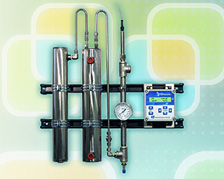
The complete Model 61 System includes ECD’s CS10 Conductivity Sensor in a rack mounted panel. The system panel features a modular design for easy installation. It includes a sediment trap for easy removal of sludge buildup, sample cooler, temperature gauge, sample control valve and safety relief valve. All wetted materials are constructed of rugged 316 stainless steel. The process connection features a compression fitting of 0.75 inch NPT to accommodate the CS10 Sensor. The system is designed to operate from temperatures of 0-100°C and at a pressure range of 0-75 psig.

The Model 61 System’s C22 Controller is a 110/220 Vac line powered, dual input device with one or more 4-20 mA outputs in addition to conductivity (pH, temperature, PID) and up to eight alarm relays as well as timers and logic functions. The C22’s 4-20 mA output can be configured as a PID control output. The PID signal modulates a control valve to keep the surface blowdown rate uniformly close to the maximum allowable dissolved solids level, regardless of load conditions.

The Model 61 System comes standard with a NEMA 4X rated T23 transmitter, which is a two wire, 4-20 mA transmitter. For hazardous conditions, the FM- and CSA-approved T-28 Transmitter is an intrinsically safe, explosion-proof two wire 4-20 mA transmitter offering the standard conductivity output.

Triton TR8 Analyzer

Triton TR8 Analyzer With Intelligent Sensor Technology for Suspended Solids Measurement in Wastewater

Ideal for the Activated Sludge Process, Return & Waste Activated Sludge, Paper Manufacturing Filtrate, Blending/Mixing Applications, Environmental Runoff

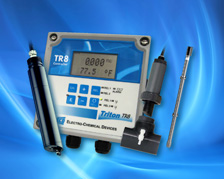
Engineers in search of a precise, highly reliable, low-maintenance water quality monitoring solution for wastewater treatment and other applications where suspended solids and turbid conditions are present will want to learn more about the Triton TR8 Analyzer from Electro-Chemical Devices (ECD).

Accurate measurement of suspended solids is critical to maintaining the proper level of activated sludge in an aeration basin. Adjustments to the return and removal rates of the activated sludge can improve the efficiency of the basin in reducing the COD and BOD of the mixed liquor. The TR8 is available with immersion fittings for service in the aeration basin or insertion fittings for the return and waste activated sludge lines.

The high range TR8 Analyzer is used to measures suspended solids or turbidity at levels greater than 500 NTU, with output available in multiple units: 0.00-9999 FNU, 0.00-9999 ppm, 0-300g/l and 0-200 percent. The TR8 TA sensor features an error rate of less than 5 percent of reading with repeatability greater than 1% percent of reading.

The Triton TR8’s sensor features a unique multi-beam optical assembly. The first light beam is a reference detector that c ompensates for changes in the LED light source caused by aging or other variables. The second light beam detects the short path length, which is best of high concentration measurement. The third light beam measures the longer path length, which is best for lower concentrations.

The Triton TR8 utilizes a highly intelligent microprocessor-based design. Its sensor electronics constantly adjusts suspended solids and turbidity signal readings versus the reference detector for superior measurement accuracy. A built-in digital filter helps to suppress potentially interfering signals while self-monitoring diagnostics assure high reliability.

The Triton TR8’s sensor assembly relies on a long-life near infrared LED light source (880 nm), and the 90-degree scattered light method in accordance with ISO 7027 / EN 27027. The sensor is factory calibrated in formazine, FNU (Formazine Nephelometric Units), and is plug-and-play ready for applications. Two nonvolatile memory banks are also available onboard to store user-initiated calibration data.

Featuring an inclined face that is oriented into the liquid flow for optimum self-cleaning, the rugged Triton TR8’s sensor assembly greatly reduces plant maintenance requirements to the occasional manual sensor swiping with a soft cloth. An optional automated mechanical wiper also is available for heavy-duty service environments or for difficult-to-reach sensor locations.

The Triton TR8’s sensor was developed for rugged water treatment environments, designed to operate at ambient temperatures from -5 to 50°C (20-120°F). It withstands pressures up to a maximum of 6 bar at 25°C and 1 bar at 50°C.

The TR8’s transmitter digitally communicates with the turbidity sensor and provides a 4-20 mA output and alarm relay. The TR8’s controller features ECD’s multi-bus architecture, with up to 2 outputs and 4 SPDT relays. It includes a configurable display and HART protocol communication is available as well. The turbidity sensor can be located up to 200 m away from the controller.

CA-6 Online Analyzer

User-Friendly, Cost-Effective CA-6 Online Analyzer For Phosphate Measurement

The easy-to-use and economical CA-6 Online Analyzer from Electro-Chemical Devices uses colorimetric analyses to accurately and reliably measure phosphate and total phosphate levels.

The CA-6 Analyzer is available in models measuring phosphate at 0-5.0 mg/L, 0-50.0 mg/L or 0-200 mg/L and total phosphate at 0-2.0 mg/L, 0-20.0 mg/L or 0-100 mg/L. Phosphate and total phosphate levels are important indicators of water quality. Sources of phosphates include sewage, industrial waste and fertilizers. Excessive phosphates can lead to extensive algae growth called “blooms” which can have serious ecological consequences.

The CA-6 precision online sequential sampling analyzer is lightweight and easy to install. Weighing less than 40 pounds, it can be wall mounted or simply set on a bench using the optional Bench Top Stand. After the sample, waste and reagent lines have been connected to the analyzer and provided with power, the CA-6 will begin its preprogrammed analysis sequence. The CA-6 is available with up to 4 channels (optional) each from a separate sample point. A simple, user-friendly menu structure and touchscreen interface makes it easy to access information or customize analyses.

The CA-6 utilizes photometric differential absorbance to analyze over 20 other common parameters in addition to phosphate including: aluminum, silica, nitrogen, iron and sulfate. It operates at a wide temperature range of 5-50°C and offers repeatability of ±2% on the absorbance value if the turbidity

The highly accurate CA-6 Analyzer improves ISE measurements requiring significant sample conditioning for measurement accuracy, reducing the volume of conditioning chemicals required and minimizing the associated waste. With the CA-6, the result is a faster, accurate measurement requiring fewer consumables with less waste to reduce overall operating costs — saving labor and money.

The CA-6 Analyzer’s easy-to-use touch-screen display shows the measured parameter, analyzer status, percent reagent volumes, time and the menu bar, which provides access to the Run, Display, Program, Service and Help menus. It includes two alarm relay outputs and a 4-20 mA channel that connects with PLC’s or distributed control systems.

The rugged and reliable CA-6 features two separate compartments to isolate liquids and electronics and is enclosed in an epoxy powder coated, cold rolled steel cabinet. The liquids enclosure houses all the components necessary for sampling and reagent flow, mixing and reaction stages (sampling pump, reagent micro-pumps and colorimetric reaction cell). The electronics enclosure contains the main power supply, the controller printed circuit board assembly and the touchscreen interface.

It is easy to use the CA-6 to create customized analysis routines and access results via the touch-screen unit’s simple menu structure and function commands. It can be programmed with numerous analysis configurations, depending on the accessories and the number of micro-pumps mounted in the liquids enclosure.